What Is Anonymization? A Complete Guide for 2026
Daniel Reeves — Privacy Counsel, JD Part of: Online Blur Tools: Complete Guide + Comparison (2026)Read the complete guide →
What Is Anonymization? A Complete Guide for 2025
Anonymize is the process of permanently removing or altering personally identifiable information (PII) from datasets so individuals cannot be identified, directly or indirectly. Unlike pseudonymization, which replaces identifiers with reversible tokens, data anonymization destroys the link between data and identity — making re-identification mathematically impossible or prohibitively difficult.
This matters because improperly anonymized data exposes organizations to massive regulatory penalties and reputational damage. Under GDPR, inadequate anonymization of personal information can trigger fines up to €20 million or 4% of global revenue — whichever is higher. In 2019, researchers re-identified 99.98% of Americans in "anonymized" datasets using just 15 demographic attributes, proving that weak de-identification techniques fail in practice. Healthcare providers face HIPAA violations averaging $1.5 million per breach when protected health information (PHI) isn't properly anonymized before sharing for research or analytics.
Why Anonymize Matters
Anonymization isn't just a technical checkbox — it's the difference between lawful data use and multi-million dollar penalties. Organizations that fail to properly anonymize personal data face regulatory action, reputational damage, and operational shutdowns. The consequences ripple across legal, ethical, and financial dimensions.
Legal and Regulatory Consequences
GDPR Article 4(5) defines anonymization as data that "does not relate to an identified or identifiable natural person." Get it wrong, and regulators strike hard. In 2020, British Airways paid a £20 million fine under GDPR for exposing 400,000 customer records — data that could have been anonymized before analysis. Under GDPR Article 83, fines reach up to €20 million or 4% of global annual turnover, whichever is higher.
HIPAA requires healthcare entities to de-identify Protected Health Information (PHI) before sharing it. The Safe Harbor method under 45 CFR §164.514(b) mandates removing 18 specific identifiers, including names, dates, and ZIP codes. In 2019, the University of Chicago Medical Center paid $1.5 million to settle a lawsuit after a data-sharing agreement with Google allegedly exposed patient records without proper anonymization.
CCPA gives California residents the right to know what personal information businesses collect. Organizations that anonymize data under CCPA §1798.140(h) — rendering it "not reasonably capable of being associated with a consumer" — can use that data without triggering disclosure obligations. In 2022, Sephora paid $1.2 million for CCPA violations related to inadequate disclosure of consumer data sales.
Privacy and Re-identification Risk
Anonymization protects individuals from surveillance, discrimination, and identity theft. But poorly executed anonymization creates a false sense of security. In 2006, Netflix released "anonymized" viewing records for a data science competition. Researchers at the University of Texas re-identified individual users by cross-referencing the dataset with public IMDb reviews — proving that removing names isn't enough when behavioral patterns remain.
The k-anonymity standard requires that each record be indistinguishable from at least k-1 other records. Yet in 2013, researchers re-identified 87% of the U.S. population using only gender, date of birth, and ZIP code — three data points often left in "anonymized" datasets. Differential privacy addresses this by adding mathematical noise, but implementation complexity means many organizations still rely on weaker techniques like data masking or tokenization.
Location data poses extreme re-identification risk. A 2013 MIT study found that four spatio-temporal points (location + timestamp) uniquely identified 95% of individuals in a "anonymized" mobile phone dataset of 1.5 million people. When the New York City Taxi and Limousine Commission released trip records in 2014, researchers de-anonymized celebrity rides by matching pickup times and locations to paparazzi photos.
Financial and Operational Impact
Anonymization failures cost organizations millions in settlements, legal fees, and lost business. In 2016, the Australian Department of Health released "de-identified" medical billing records for 10% of the population. Privacy advocates re-identified high-profile individuals within hours, forcing the government to withdraw the dataset and suspend the open data program. The incident cost taxpayers millions in remediation and damaged public trust in health data sharing.
ISO 27001 certification — a requirement for many enterprise contracts — mandates data protection controls including anonymization where appropriate. Organizations without proper anonymization processes risk losing certification and the business opportunities tied to it. In regulated industries like finance and healthcare, inadequate anonymization can trigger audits, license suspensions, and criminal liability for executives under laws like Sarbanes-Oxley.
The reputational damage extends beyond fines. After the 2019 Capital One breach exposed 100 million customer records, the company's stock dropped 6% and the former AWS engineer responsible faced federal charges. While the breach involved unauthorized access rather than anonymization failure, the incident highlights how data exposure — preventable through proper de-identification — destroys stakeholder confidence.
Research institutions face unique consequences. In 2021, the Dutch Data Protection Authority fined a university €50,000 for sharing insufficiently anonymized student data with a third party. The penalty forced the institution to overhaul its data governance framework, delaying multiple research projects and costing hundreds of thousands in compliance consulting.
How Anonymization Works
Anonymization removes identifying information from data so no one can trace it back to a specific person. The process varies based on data type, but the goal stays constant: destroy the link between data and identity while preserving the data's usefulness.
Manual Anonymization
Manual anonymization requires humans to review data and remove or alter identifiable elements. A hospital clerk might black out patient names on printed medical records with a marker before filing them. A researcher might manually delete email addresses from a survey spreadsheet before analysis.
This method works for small datasets — 50 survey responses, 20 interview transcripts. But it fails at scale. Processing 10,000 patient records manually takes weeks and introduces human error. A tired clerk misses a Social Security number. A researcher forgets to remove a phone number buried in a text field. One oversight turns anonymized data into a GDPR violation.
Manual methods also struggle with video and image data. Blurring faces in a 30-minute CCTV clip frame-by-frame in Premiere Pro takes 2+ hours. You scrub through the timeline, draw masks around each face, keyframe the masks as people move. Miss one frame, and the person's face appears for a split second — enough to identify them.
Software-Assisted Anonymization
Specialized software automates parts of the anonymization workflow. Data masking tools like IBM InfoSphere scan databases and replace real values with fake ones — "John Smith" becomes "Patient_4729", john.smith@email.com becomes masked_user_4729@example.com. The software applies consistent rules: all email addresses get tokenized, all dates get shifted by a random offset.
This approach handles structured data (databases, spreadsheets) efficiently. A hospital can process 100,000 patient records in hours instead of weeks. But software-assisted tools require configuration. You must define which fields contain PII, choose masking techniques for each field type, and validate the output. If you misconfigure the rules, the tool might leave Social Security numbers intact while masking harmless department codes.
Video anonymization software like DaVinci Resolve or After Effects speeds up the manual process but still demands operator input. You select regions to blur, adjust tracking parameters, review every scene for missed faces. A 10-minute dashcam clip still takes 20-30 minutes to process.
AI-Powered Anonymization
AI-powered tools use machine learning to detect and anonymize PII automatically. Upload a dataset, and the AI scans for patterns matching names, addresses, phone numbers, credit card numbers. No manual tagging required — the model recognizes "123-45-6789" as a Social Security number and "john.doe@company.com" as an email address.
For visual data, AI face detection eliminates manual masking. blur.me processes a 5-minute video in ~30 seconds — upload the file, AI detects every face across all frames, apply blur, download. No keyframing, no frame-by-frame review. The AI tracks faces as they move, turn, and disappear behind objects. A 100-photo event album processes in ~5 minutes total.
AI anonymization scales to datasets manual methods can't touch. A city government de-identifying 500 hours of police body camera footage for public release — manual editing would take months. AI processes the entire archive in days. The trade-off: AI models require training data and computational resources. Small organizations might lack the infrastructure to run advanced anonymization models in-house.
Best Practices for Anonymizing Data
Follow these six practices to minimize re-identification risk, maintain compliance, and preserve data utility across your privacy workflows.
Audit Every Output Before Release
Run a second-pass review on every anonymized dataset before sharing it externally. Re-identification attacks succeed in 15-30% of cases where organizations skip manual verification — researchers at Imperial College London de-identified 99.98% of anonymized credit card transactions by cross-referencing just three data points (location, time, merchant type). One overlooked identifier in a GDPR-covered dataset can trigger penalties up to €20 million or 4% of annual revenue.
Validation check: Export a sample of 50-100 records and attempt to match them against your original dataset using common attributes (ZIP code + birth date + gender). If you can re-identify anyone, your anonymization failed.
Apply K-Anonymity with K ≥ 5 for Shared Datasets
Set your k-anonymity threshold to at least 5 — meaning every record must be indistinguishable from at least 4 others when grouped by quasi-identifiers (age, ZIP code, occupation). Datasets with k=2 or k=3 are vulnerable to linkage attacks: the Netflix Prize dataset with k=2 was de-anonymized by matching viewing patterns to public IMDb reviews, exposing 500,000+ subscribers. HIPAA Safe Harbor requires removing 18 identifier types, but that's insufficient without k-anonymity for small population groups.
Validation check: Query your anonymized dataset for unique combinations of quasi-identifiers. If any combination appears fewer than 5 times, re-generalize those attributes (e.g., change "age 37" to "age 35-40").
Use Differential Privacy for Statistical Queries
Add calibrated noise to aggregate query results when sharing statistics from sensitive datasets. Differential privacy guarantees that adding or removing one person's data changes the query output by no more than ε (epsilon) — the U.S. Census Bureau uses ε=19.61 for 2020 census data, preventing identification of individuals while maintaining population-level accuracy. Without differential privacy, attackers reconstruct individual records by running multiple queries and comparing results — Massachusetts Group Insurance Commission data was de-identified this way, exposing Governor William Weld's medical records.
Validation check: Run the same query 10 times with noise injection enabled. Results should vary slightly but remain within your acceptable error margin (typically ±5% for population statistics).
Document Every Anonymization Decision
Maintain a data protection impact assessment (DPIA) that logs which anonymization techniques you applied to each field, why you chose them, and what re-identification risk remains. GDPR Article 35 requires DPIAs for high-risk processing — regulators rejected 40% of anonymization claims in 2022-2023 enforcement actions because organizations couldn't prove their techniques prevented re-identification. Without documentation, you can't demonstrate compliance when audited.
Validation check: Your DPIA must answer three questions for every anonymized field: (1) What technique did you use? (2) What's the residual re-identification risk? (3) Can you reverse the anonymization? If you can't answer all three, your documentation is incomplete.
Separate Direct Identifiers Before Applying Techniques
Remove names, email addresses, phone numbers, and government IDs (Social Security numbers, passport numbers) in a separate pre-processing step before applying anonymization techniques to quasi-identifiers. This two-stage approach prevents leakage — if your k-anonymity grouping fails, direct identifiers are already gone. The AOL search data leak in 2006 exposed 650,000+ users because the company released "anonymized" search logs without removing user IDs first, allowing journalists to identify individuals by their search patterns alone.
Validation check: Export your anonymized dataset and search for regex patterns matching email formats (\b[A-Za-z0-9._%+-]+@[A-Za-z0-9.-]+\.[A-Z|a-z]{2,}\b) and phone numbers (\d{3}-\d{3}-\d{4}). Zero matches = successful removal.
Test Re-Identification Risk with Real Attack Scenarios
Simulate linkage attacks by attempting to match your anonymized data against publicly available datasets (voter registrations, property records, social media profiles). Academic studies show 87% of U.S. residents can be uniquely identified using just ZIP code, birth date, and gender — your anonymization must withstand these attacks. If you're releasing video footage, test whether face recognition APIs (AWS Rekognition, Microsoft Azure Face) can match blurred faces to social media photos.
Validation check: Upload 10 sample images from your anonymized video to a reverse image search tool (Google Images, TinEye). If any faces return matches to the original subjects, your blur radius or pixelation level is insufficient. For structured data, use record linkage software (Dedupe.io, FRIL) to attempt matching against public datasets — success rate should be <5%.
Best Anonymize Tools
| Feature | Blur.me | Redact | Premiere Pro | Brighter AI | Celantur | Facepixelizer |
|---|---|---|---|---|---|---|
| Price | Free tier + paid plans | $299/year | $22.99/mo | Custom quote | Custom quote | Free |
| Platform | Web/Mobile | Desktop/Cloud | Desktop | API/Cloud | API/Cloud | Web |
| Speed | 5-min video in ~30s | 10-min video in 2-3 min | 20+ min manual work | Real-time processing | Batch: 1,000 images/hour | Single image in 5s |
| Auto-Detection | Yes (98%+ faces, plates) | Yes (faces, plates, screens) | No (manual masking) | Yes (full body + objects) | Yes (faces, plates, text) | Yes (faces only) |
| Batch Support | Yes (unlimited files) | Yes (50 videos/batch) | No (one-by-one) | Yes (API-driven) | Yes (unlimited via API) | No (single images) |
| Export Formats | MP4, JPG, PNG | MP4, MOV, AVI | MP4, MOV, ProRes | MP4, JPEG | JPEG, PNG, MP4 | JPG, PNG |
| Learning Curve | Beginner | Intermediate | Advanced | Advanced (API setup) | Advanced (developer tool) | Beginner |
| Best For | Fast browser-based anonymization | Law enforcement CCTV | Professional video editors | Enterprise street imagery | Automotive/mapping data | Quick photo redaction |
Blur.me handles both photos and videos through a simple upload workflow — no software installation required. Redact targets law enforcement with desktop software for case file redaction. Premiere Pro gives professional editors full manual control but requires 20+ minutes of keyframe work per video. Brighter AI and Celantur serve enterprise clients processing street-level imagery at scale — both require API integration and developer resources.
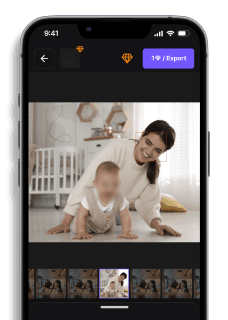
For creators, researchers, and compliance teams needing quick anonymization without technical setup, Blur.me delivers the fastest path from upload to download. A 5-minute dashcam clip processes in ~30 seconds vs 2+ hours of frame-by-frame masking in Premiere Pro. The AI detects faces and license plates automatically — blue bounding boxes appear around every detected object, and you can toggle any one off with a single click. Facepixelizer works for single photos but lacks video support and batch processing. If you need real-time anonymization for live CCTV feeds or API-driven workflows, Brighter AI or Celantur fit better — but expect months of integration work and custom pricing negotiations.
When manual masking in Premiere Pro takes 20+ minutes per video and Redact costs $299/year for desktop-only access, blur.me processes the same 5-minute clip in ~30 seconds through any browser — no installation required.
Faces or plates to hide in your photo?
Upload and the AI blurs them automatically in seconds.
FAQ
What does anonymize mean?
Anonymize means permanently removing or altering identifying information from data so individuals cannot be recognized. Unlike pseudonymization, which replaces identifiers with codes that can be reversed, anonymization destroys the link between data and identity irreversibly. GDPR Article 4(5) defines it as processing that prevents re-identification "without disproportionate effort." For example, blurring faces in a photo or replacing names with random IDs in a dataset.
What's the difference between anonymization and pseudonymization?
Anonymization permanently removes all identifiers — you cannot reverse it. Pseudonymization replaces identifiers with codes or tokens that can be reversed using a separate key. GDPR treats pseudonymized data as personal data (still regulated), while anonymized data falls outside GDPR scope. Healthcare systems use pseudonymization for research (linking patient records later), while public agencies use anonymization for CCTV footage release. Choose anonymization when you never need to re-identify individuals.
How do you anonymize objects in videos?
Upload your video to blur.me and select objects to blur — faces, license plates, logos, or any region. The AI tracks selected objects across all frames automatically, applying irreversible blur in approximately 30 seconds for a 5-minute clip. Manual tools like Premiere Pro require 15+ minutes of keyframe masking for the same result. Blur.me supports batch processing for multiple videos and works entirely in your browser with no installation required.
What are the most common anonymization techniques?
Data masking replaces sensitive values with realistic fake data (names, addresses). K-anonymity groups records so each individual shares attributes with at least k-1 others — preventing singling out. Differential privacy adds mathematical noise to datasets, protecting individuals while preserving statistical patterns. Video anonymization applies blur or pixelation to faces and identifiable objects. Healthcare uses data redaction for PHI, while enterprises combine techniques — masking for structured data, blur for visual content.
Can anonymized data be re-identified?
Yes — poorly anonymized data can be reversed through re-identification attacks. In 2006, Netflix released "anonymized" viewing data, but researchers re-identified 99% of users by cross-referencing IMDb reviews. Location data is especially vulnerable — MIT found four timestamped locations uniquely identify 95% of individuals. True anonymization requires removing quasi-identifiers (age, ZIP code, gender combinations) and applying techniques like k-anonymity (k≥5) or differential privacy. GDPR requires anonymization to withstand re-identification "without disproportionate effort."
Faces or plates to hide in your photo?
Drop a photo or video in your browser and the AI auto-blurs faces, license plates, and personal info in seconds.
Upload free